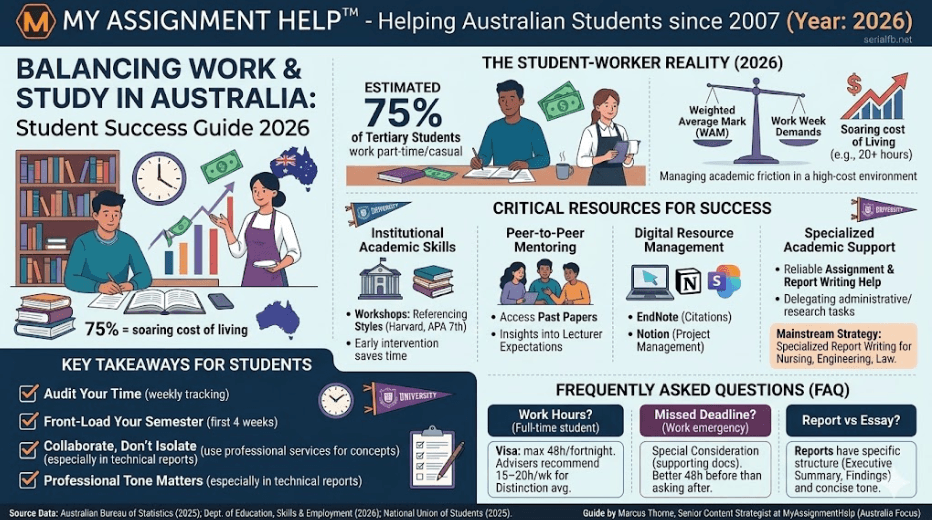
Australia continues to be a top-tier destination for higher education, attracting a diverse cohort of international and domestic students to its prestigious institutions. However, the modern student experience in 2026 is increasingly defined by a complex dual identity: the “student-worker.” With the cost of living in major urban centres like Sydney, Melbourne, and Perth reaching historic highs, approximately 75% of tertiary students now engage in part-time or casual employment to sustain their education. This shift has transformed the academic journey from a singular focus on learning into a high-stakes balancing act.
The pressure to maintain a high Weighted Average Mark (WAM) while meeting the demands of a 24-hour work week can lead to significant academic friction. Strategic time management and early intervention are no longer optional—they are survival traits. For many students navigating these rigorous requirements, the availability of reliable assignment help, Australia-wide serves as a vital academic safety net. By delegating administrative or preparatory research tasks to experts, students can ensure their financial commitments do not compromise their long-term career prospects or academic standing.
The Evolving Educational Landscape in Australia
Success in the Australian university system is rooted in a culture of independent research and critical enquiry. Unlike systems that rely on rote learning, Australian assessors prioritise original thought and evidence-based arguments. For a student working back-to-back shifts in hospitality or retail, finding the deep-focus time required to synthesise complex data is an immense challenge. Data from the 2025 National Student Survey indicates that academic stress is the leading cause of “deferred units,” with over 30% of students citing work-study conflict as their primary hurdle.
The complexity is further heightened during the mid-semester peak. This is the period when large-scale projects and technical reports are due simultaneously. Because the Australian academic framework places heavy emphasis on industrial relevance, students are often tasked with creating professional-grade documents. Consequently, seeking specialized report writing help has become a mainstream strategy for students in Nursing, Engineering, and Law, where the formatting and tone of a report are just as critical as the content itself.
Essential Resources for Student Success
- Institutional Academic Skills Units: Most Australian universities provide workshops on referencing styles (such as Harvard and APA 7th). Utilizing these services early can save hours of revisions during finals week.
- Peer-to-Peer Mentoring: Joining a student society provides access to “past papers” and peer insights into specific lecturers’ expectations.
- Digital Resource Management: In 2026, mastering software like EndNote for citations and Notion for project management gives students a distinct advantage.
Key Takeaways for Students
- Audit Your Time: Track every hour for one week to identify where time is being leaked.
- Front-Load Your Semester: Complete 50% of your reading in the first four weeks before work shifts ramp up.
- Collaborate, Don’t Isolate: Use professional services to understand difficult concepts rather than staring at a blank screen.
- Professional Tone Matters: Especially in technical reports, the ‘voice’ of your writing determines your grade tier.
See also: Field sales management software: everything sales leaders need to know
Frequently Asked Questions (FAQ)
1. How many hours should I work while studying full-time?
While visa regulations allow international students up to 48 hours per fortnight, most academic advisors recommend a maximum of 15–20 hours per week to maintain a Distinction-level average.
2. What happens if I miss a deadline due to a work emergency?
University policies usually require an application for “Special Consideration” with supporting documentation. It is always better to seek assistance 48 hours before a deadline than to ask for an extension after the fact.
3. Why is report writing more difficult than essay writing?
Reports require a specific structure (Executive Summary, Findings, Recommendations) and a concise, objective tone. Many students find this transition difficult without external guidance.
About the Author
Marcus Thorne is a Senior Content Strategist at MyAssignmentHelp with a focus on Australian higher education trends. With a background in academic counseling and SEO analysis, Marcus has helped thousands of students in Sydney and Brisbane optimize their study workflows through data-driven content strategies.
References & Data Sources:
- Australian Bureau of Statistics (2025). Characteristics of Recent Graduates.
- Department of Education, Skills and Employment (2026). Higher Education Statistics Collection.
- National Union of Students (Australia). The 2025 Student Poverty and Employment Report.