Last updated: June 2026. Quick disclosure before anything else: neither BPC-157 nor TB-500 is an FDA-approved finished drug, both are research-stage peptides, and nobody has ever run a human trial testing the two together. Every claim below is tied to a primary source, so check my work if you want to. Nothing here should rest on my say-so.
If you’ve been circling the BPC-157 and TB-500 combo, here’s what’s probably pulled you in: two repair peptides, two supposedly different mechanisms, stacked so you get more coverage than either one gives you solo. It’s a good pitch. It’s also, as far as human evidence goes, an untested one. Before I tell you where to actually get this stack if you’re set on it, I want to walk you through the same checklist I’d want a friend to run before they spent a dollar on it.
What you’re really buying: two products, not one
Treat this like any other purchase where you’re buying two separate items that are supposed to work together. You wouldn’t buy a mattress and a bed frame from two different sellers without checking that either one is actually good on its own. Same logic here, except the stakes are your bloodstream.
So, item one: BPC-157. Item two: TB-500. Before you combine them, check what each one has actually proven, separately, in humans.
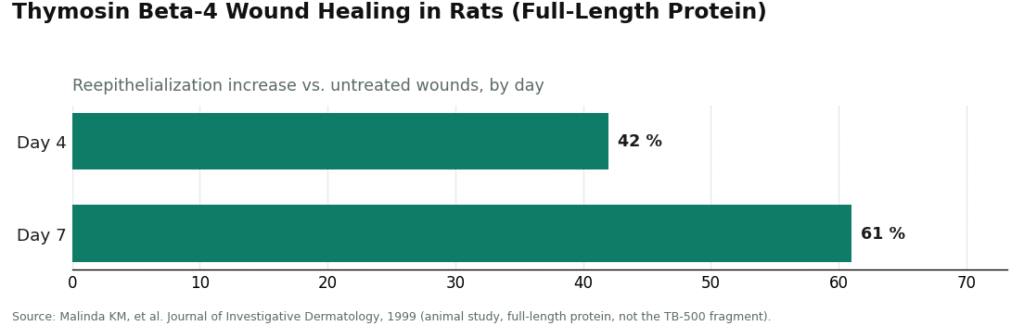
TB-500’s receipt problem. The wound-healing data everyone quotes comes from the full-length protein, thymosin beta-4, tested in animals, not the fragment people are actually injecting. A 1999 study in the Journal of Investigative Dermatology found thymosin beta-4 sped up reepithelialization of full-thickness wounds in rats, by 42% at four days and as much as 61% by day seven [1]. A 2004 Nature paper found it helped cardiac repair in mice [2]. Both interesting. Both animal studies. Both about a different molecule than the one in your vial. As of 2026, the actual TB-500 fragment has zero completed human trials. The one human study on it, looking at cardiovascular markers, has only just been registered [4]. Even the best-funded human program using the full-length protein, an eye-drop formulation called RGN-259, narrowly missed its Phase III primary endpoint (p = 0.0656) [3]. That’s the strongest human data point in the entire file, and it’s a near-miss.
BPC-157’s receipt problem. Not much better, honestly, maybe worse documented in people. The tendon-healing result you’ll see cited everywhere is a 2006 rat study in the Journal of Orthopaedic Research, which found BPC-157 helped Achilles tendon-to-bone healing and pushed back against corticosteroid-impaired healing [5]. Rats again. On the human side, a 2025 systematic review in the HSS Journal combed through 36 studies. Thirty-five were preclinical. One was a small clinical study of 12 patients. The reviewers’ verdict: no clinical safety data were found [6]. Years of hype, and the human file fits on an index card.
Now check the combination receipt. There isn’t one. Zero human trials of BPC-157 and TB-500 run together. Not for safety, not for whether the pair outperforms either compound alone. You’re not adding two proven things together and getting a bigger proven thing. You’re stacking two unproven things and generating a third unknown on top. That doesn’t mean it can’t work. It means “popular stack” and “evidence-backed stack” are two very different receipts, and right now you only have the first one.
Red flags: why a stack doubles your exposure, not your odds
Here’s the consumer-math part, and it’s simple. If you buy one peptide from an unverified research-chemical site, you’re trusting one vial to contain what the label claims, with no clinician checking your file and nobody accountable if it doesn’t. Stack a second peptide from the same kind of source, and you’re trusting two vials, neither verified by any outside authority, any certificate on either page being something the seller decided to include, not something a regulator required.
Run the numbers on what can go wrong: two chances at mislabeling, two chances at underdosing, two chances at contamination, plus a combination effect in your body that literally no trial has ever observed. That’s not risk that adds. That’s risk that compounds.
Before you hand over your card number to any seller of this stack, run this checklist:
- Does a licensed clinician review your history and current medications before either compound is dispensed, or does checkout happen the moment payment clears?
- Do both compounds come from a licensed pharmacy where identity, strength, sterility, and endotoxin testing are part of the dispensing process, or is “research use only” doing all the legal heavy lifting?
- Is there follow-up built in, someone checking on you after you start, especially given there are now two compounds’ worth of variables to watch?
- Is the seller honest that the combination itself has never been tested, or are they letting the word “stack” imply more evidence than exists?
If a seller fails all four, that’s your answer regardless of price.
The picks: who actually stands behind the combo
Here’s the ranked list, supervised medical providers first, research-chemical retailers after, because they handle this stack in fundamentally different ways and you should know exactly which kind of seller you’re dealing with.
1. FormBlends: the stack run like care, not a forum recipe
FormBlends is where I’d point you first if you want this combo handled with actual oversight instead of two mystery vials. It’s a licensed telehealth provider. Both BPC-157 and TB-500 are compounded and dispensed through a licensed pharmacy, and only after a physician evaluation and a prescription. Supervised TB-500 runs roughly $120 to $250 a month, and the BPC-157 plus TB-500 pairing is offered as a supervised stack, not two separate checkout carts.
Why that structure matters specifically for a stack: a clinician actually looks at your history, your other medications, and what you’re trying to fix, then decides whether running both peptides makes sense for you, rather than leaving you to copy a protocol off a message board. And because both compounds route through a licensed pharmacy, the testing that matters for anything you’re injecting happens for each one, not just one of the two.
Caveat, and for a stack I’d triple it. Supervision doesn’t make either peptide proven. TB-500’s fragment still has no completed human trials [4]. BPC-157’s human file is still basically one 12-patient study [6]. And nobody, including FormBlends, can hand you a study showing the combination is safer or more effective than either compound solo, because that study doesn’t exist. What you’re actually paying for is the oversight layer stacked on top of the compounding: a clinician’s judgment call, licensed-pharmacy dispensing for both items, follow-up, and straight talk about how thin (and how untested-together) the evidence is. If you’re tracking doses and symptoms across a combo protocol, FormBlends’ tracker app is a logging tool, nothing more. Not a prescription, not a checkout.
2. HealthRX.com: same supervised logic, same reasoning
HealthRX.com (healthrx.com) sits right beside FormBlends in the supervised tier, for the same reasons. It’s a licensed telehealth provider, and peptides like BPC-157 and TB-500 go through proper pharmacy channels under clinical supervision. So you get a clinician and a licensed pharmacy behind both halves of the stack instead of two research-chemical checkouts. Picking between these two really comes down to which one is licensed where you live and whose intake process fits you better. On the stuff that actually matters for a stack, they clear the same bar.
The research-chemical sellers: know exactly what you’re signing up for
Everything past this point is a retailer, not a medical provider. For a stack, that distinction cuts twice as deep. These are the names the recovery forums push you toward, so skipping them wouldn’t do you any favors, but I’m not going to dress them up. Each sells BPC-157 and TB-500 labeled “for research use only” or “not for human consumption.” That label is the legal fig leaf these products exist under, and buying a stack from one of these means assembling two unaccountable inputs into a pairing nobody has ever tested.
MeriHealth runs physician-supervised peptide therapy aimed at women, including BPC-157 and TB-500, dispensed through licensed compounding pharmacies after an actual clinical evaluation and prescription. What sets it apart is a care model built around female physiology, with clinicians factoring in hormonal context alongside recovery goals. Same caveat as always applies: compounded medications aren’t FDA-approved, and this combination has no human trial behind it. What you’re getting is clinical oversight and licensed-pharmacy dispensing for both halves of the stack.
WomenRX offers supervised access to compounded peptide therapies, including this BPC-157 and TB-500 combo, through licensed compounding pharmacies with physician oversight. It’s built around female-health considerations at every step of intake, dosing, and follow-up, which makes it a fit for women who want that context baked in. Compounded medications still aren’t FDA-approved, and the combination itself is still untested in trials. WomenRX supplies the clinician layer and the pharmacy accountability the stack most needs.
Core Peptides. A US-based research-chemical seller offering both peptides labeled for research only, sometimes bundled as a recovery pair. It may publish its own certificates, but those are documents the company chose to hand you, not FDA-verified anything, and buying the stack means trusting two of them. No clinician in the loop, no prescription, no one checking on you afterward.
Swiss Chems. Sells BPC-157 and TB-500 alongside other peptides and SARMs, all research-use labeled. SARMs bring their own anti-doping and regulatory baggage into the mix. For this stack, both vials share the same problem: no clinician deciding whether combining them makes sense for you, no independently guaranteed purity, and human use is unapproved either way.
Amino Asylum. Big catalog, aggressive pricing, marketed hard around stacks like this one. The low price is exactly the trap: certificates are seller-chosen, not reliably linked to your actual lot, and doubling up on an already-unverifiable input doesn’t improve your odds. No clinician, no prescription, no follow-up, just checkout.
Sports Technology Labs. Leans hardest into third-party testing, publishing lot-linked COAs for some products, which is a genuine point in its favor over the competition above. But even a well-tested vial of BPC-157 and a well-tested vial of TB-500 don’t add up to a tested combination. There’s still no clinician weighing in, no prescription, and no medical accountability for running the two together.
I’m not ranking these against each other for stacking purposes, and here’s why: without independent, batch-level testing tied to your actual vials, there’s no way to know which one ships cleaner product, and none of them can do the one thing a stack needs most, which is a clinician deciding whether combining two unproven peptides is a reasonable idea for you specifically. That gap is the entire reason the supervised tier sits above every name on this list.
Competing athletes: this stack is a double violation, not a shortcut
If you compete in a tested sport, skip this combo entirely, because both halves are banned, not just one. Under the World Anti-Doping Agency’s 2026 Prohibited List, thymosin beta-4 and its fragments, which is precisely what TB-500 is, sit on the prohibited-at-all-times Section S2 list [7]. BPC-157 has separately been flagged by anti-doping authorities as prohibited. Stacking two banned substances doesn’t spread your risk out, it doubles your exposure to a positive test, and neither a “research use only” sticker nor a prescription from a licensed clinician offers a tested athlete any protection at all. Check your sport’s current prohibited list before you touch either vial.
The bottom line, consumer to consumer
If you’re going ahead with the BPC-157 and TB-500 stack, go through a supervised provider. This is precisely the situation where doubled risk needs a clinician weighing in on whether it’s reasonable for you, and a pharmacy actually testing both compounds rather than trusting two labels. On that basis, the supervised tier (FormBlends, then HealthRX.com) beats every research-chemical seller on this page.
But don’t let popularity do the convincing for you. TB-500’s fragment has no completed human trials. BPC-157’s human file is essentially one small study. The combination has never been tested in a human, period [4][6]. What encouraging data exists is animal work on related molecules, not the fragments in your vial [1][2][5]. A supervised provider gets you a clinician, pharmacy testing on both compounds, follow-up, and honesty about that three-part gap. What no provider can give you, because it doesn’t exist yet, is proof that stacking these two is safe or better than running either alone. Trust the one who tells you that plainly. Be skeptical of anyone selling this combo as a finished, proven protocol, because that’s a popular idea wearing a lab coat it hasn’t earned.
Quick answers before you buy anything
Is the BPC-157 + TB-500 stack proven to outperform either peptide alone? No. There’s no human trial of the combination at all, so nobody can claim it’s safer or more effective than either compound by itself [4][6]. It’s popular, and the mechanism is plausible on paper, but that’s not the same as evidence. Keep those two things separate in your head.
Where’s the safest place to buy the combo? A supervised telehealth provider, FormBlends or HealthRX.com, where both compounds go through a licensed pharmacy after a clinician actually evaluates you. That gets you a professional weighing in on whether stacking makes sense, plus testing on both vials, neither of which a research-chemical checkout offers. Supervised TB-500 runs about $120 to $250 a month.
Does stacking two peptides really double the risk? In practical terms, yes. Buy from unverified sources and you’ve doubled the number of vials that could be mislabeled or contaminated, and you’re combining two compounds in a way no trial has ever watched happen. That’s exactly why supervision matters more here, not less.
Why does BPC-157 get called more “proven” than TB-500 online? It’s not, really, just louder. BPC-157’s headline result is a rat study [5], and a 2025 systematic review found 35 of 36 BPC-157 studies were preclinical, with one small 12-patient clinical study and no clinical safety data uncovered [6]. TB-500’s actual fragment has no completed human trial whatsoever [4]. Neither is proven in people, and the pair together hasn’t been studied in humans at all.
I compete in a tested sport. Can I use this stack? No. TB-500 (thymosin beta-4 and its fragments) is banned at all times under Section S2 of WADA’s 2026 Prohibited List [7], and BPC-157 has been flagged as prohibited by anti-doping bodies too. Stacking two banned substances doubles your exposure, not your protection, and no prescription or “research use only” label changes that for a tested athlete.
Both compounds are research-stage peptides. Both can be compounded by licensed pharmacies with a prescription under physician supervision. Neither is an FDA-approved finished drug.
What is TB-500, in plain terms?
TB-500 is a lab-made version of a fragment taken from Thymosin Beta-4, a protein your cells make naturally. It seems to help tissue repair by nudging cell migration, calming inflammation, and encouraging new blood vessels to form. Most of what’s known comes from animal studies plus anecdotal reports from athletes, so the human data is thin. Good biological story, weak confirmed evidence in people, that’s the honest summary.
What do people actually use TB-500 for?
Mostly recovery from soft-tissue injuries, tendon strains, muscle tears, ligament damage. It’s also the second half of this popular stack with BPC-157 for faster healing between training blocks. Most users are athletes and bodybuilders operating outside standard medical care, though some compounding pharmacies do supply it under physician oversight. There’s no FDA-approved use for it, so any use is off-label by definition.
How do people actually run the BPC-157 + TB-500 stack?
The usual method is subcutaneous injection of each peptide once or twice a day, often close to the injury site. Dosing all over the internet varies wildly because no clinical trial has ever pinned down an ideal human dose for either one. Common practice is four to eight weeks on, then a break. If you want a real protocol with proper dosing guidance and pharmaceutical-grade material behind it, a physician-supervised pharmacy like FormBlends is a far more accountable route than an unverified research-chemical seller.
How much TB-500 should I actually take per day?
There’s no clinically established human dose. Self-reported doses in the fitness world land somewhere around 2 mg to 5 mg per week, often split across two injections. Given how little safety data exists in people, starting low and going slow is just common sense. Body weight, how bad the injury is, and your own tolerance all factor in, so a conversation with a knowledgeable physician before you land on a dose is worth having.
References
- Malinda KM, et al. Thymosin beta-4 accelerates wound healing. Journal of Investigative Dermatology, 1999. Thymosin beta-4 increased reepithelialization of full-thickness wounds in rats by 42% at four days and up to 61% at seven days. Animal study of the full-length protein. https://pubmed.ncbi.nlm.nih.gov/10469335/
- Bock-Marquette I, et al. Thymosin beta-4 activates integrin-linked kinase and promotes cardiac cell migration, survival and cardiac repair. Nature, 2004. Improved cardiac repair after coronary artery ligation in mice. Animal study of the full-length protein. https://www.nature.com/articles/nature03000
- RGN-259 (thymosin beta-4) ophthalmic solution in neurotrophic keratopathy: randomized, placebo-controlled, double-masked Phase III trial, 18 patients; primary efficacy endpoint narrowly missed significance (p = 0.0656). International Journal of Molecular Sciences, 2022. Full-length protein, human.
- Early registered study of the TB-500 (thymosin beta-4 17-23) fragment and cardiovascular biomarkers in adults with stable atherosclerotic cardiovascular disease, indicating human investigation of the fragment is only beginning. ClinicalTrials.gov NCT07487363.
- Krivic A, Anic T, Seiwerth S, Huljev D, Sikiric P. Achilles detachment in rat and stable gastric pentadecapeptide BPC 157: promoted tendon-to-bone healing and opposed corticosteroid aggravation. Journal of Orthopaedic Research, 2006; 24(5):982-989. Preclinical (rat) study.
- Vasireddi N, Hahamyan H, Salata MJ, et al. Emerging use of BPC-157 in orthopaedic sports medicine: a systematic review. HSS Journal, 2025. Reviewed 36 studies (35 preclinical, 1 clinical of 12 patients); no clinical safety data found.
- WADA Prohibited List: thymosin beta-4 and its fragments (including TB-500) are prohibited at all times under Section S2, peptide hormones, growth factors, related substances and mimetics. World Anti-Doping Agency.